dotint.careers has crossed a useful milestone: more than 10,000 vacancies processed.
That is not a huge number by general job-board standards. But for international organisations, foundations, development banks, humanitarian organisations, and public-sector-adjacent institutions, it is already large enough to stop treating each vacancy as an isolated announcement. Patterns begin to show.
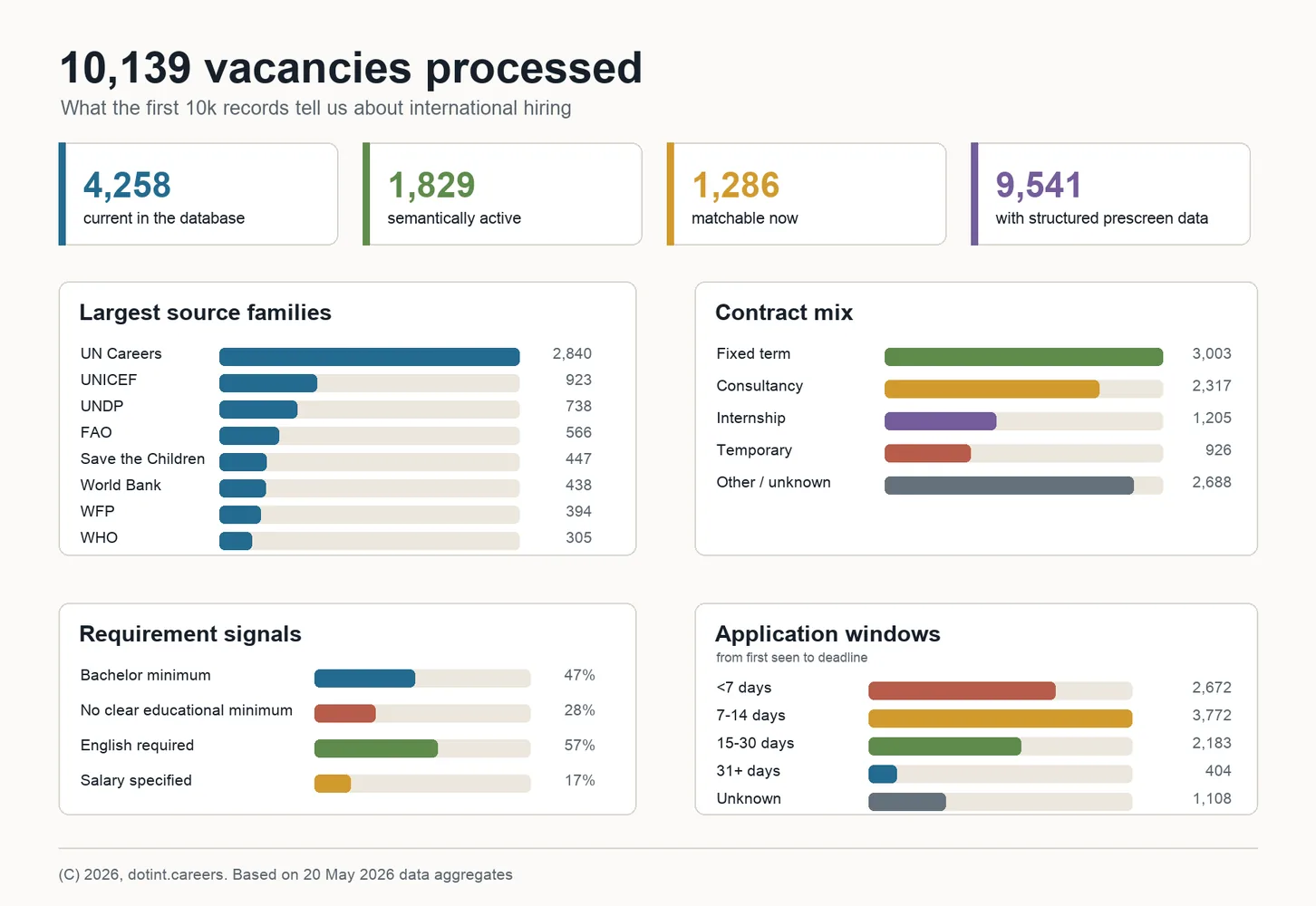
The current production snapshot contains 10,139 vacancy records. Of those, 4,258 are still current in the database, 1,829 are semantically active, and 1,286 are currently matchable after excluding vacancies that have expired, gone stale, or are of insufficient quality or missing information needed for matching.
That narrowing is a good reminder of what dotint.careers is trying to do. The platform is not built to make the market look bigger. It is built to make the usable part of the market clearer.
The market is broad, but not evenly distributed
The first 10,000 records are dominated by a relatively small number of source families.
United Nations Careers is the largest source in the database, with 2,840 records. UNICEF, UNDP, FAO, Save the Children, the World Bank Group, WFP, WHO, UNHCR, UNESCO, OSCE, EU agencies, ICRC, EPSO, UNFPA, GIZ, UNOPS, IAEA, EIB, and ESA make up much of the next tier.
That does not mean smaller sources are unimportant. In fact, one of the main values of dotint.careers is catching opportunities from many organisations that no single candidate would check every day. But the distribution matters: a candidate's experience of the market will often be shaped by a few very active publishing systems, while the long tail adds breadth, specialist niches, and occasional opportunities that are easy to miss.
There is also a live-market version of the same pattern. Among current records, United Nations Careers, UNICEF, UNDP, Save the Children, FAO, WFP, the World Bank Group, WHO, OSCE, UNFPA, UNESCO, GIZ, ESA, ICRC, and EU agencies are still the main visible sources.
The market is less staff-only than it looks
The contract mix is one of the clearest signals in the data.
Fixed-term roles are the largest identifiable category, with 3,003 records. Consultancies are close behind at 2,317. Internships account for 1,205 records, and temporary roles for 926. There are also rosters, secondments, fellowships, volunteer roles, and a large group where the contract type is still unknown or not cleanly stated.
For candidates, this matters because these are not just administrative labels. They affect eligibility, compensation, mobility, selection style, and whether the role is a serious career move or a short assignment. Two vacancies can look similar in title and theme, but behave very differently once contract type, grade, duration, and hiring route are taken into consideration.
This is also where automated matching has to be conservative. A good match for a staff role is not automatically a good match for a consultancy. A strong consultancy profile is not always competitive for a fixed-term international post. The vacancy universe is not one market; it is several overlapping markets using similar language.
Requirements are often formal, but not always transparent
The structured prescreen data covers 9,541 of the 10,139 vacancies.
Within that prescreened set, the most common minimum education level is bachelor's level, appearing in 4,463 records. Master's-level minimums appear in 988 records. Secondary-level requirements appear in 1,110. In 2,695 records, the degree level is still unknown or not stated clearly enough to rely on.
Experience requirements show a similar pattern. The biggest identifiable band is 3-5 years, with 2,244 records. Another 1,127 require 6-8 years, 548 require 9-12 years, and 163 require 13 or more years. 4,629 prescreened vacancies do not have a clean minimum-years value.
That last number is important. Missing or vague requirements are not just a data-quality inconvenience. They affect candidates directly. If a vacancy does not state enough about education, experience, languages, location, work authorization, or contract conditions, the candidate has to spend more time interpreting it, and the system has to be more cautious when matching it. dotint.careers is about saving our users time and frustration while giving them access to the full breadth of the market, and this is what we do.
The same is true for salary. Only 1,609 prescreened vacancies include a detected salary currency. That does not mean the rest are unpaid; many are paid roles where compensation is absent, deferred to a scale, hidden in a separate document, or described in a way that is hard to normalize. But from the candidate's point of view, the practical result is the same: a large share of the market asks for serious effort before giving basic compensation clarity. So far, dotint.careers is only able to infer UN salaries for you, we are working to add other salary calculators to the service. But a general call is for employers to include salary ranges in plain sight: that's just about playing a fair game in recruitment where the balance of power is inherently not in the jobseekers' favour.
Languages are a real eligibility gate
English is by far the most common required language in the prescreened data, appearing as a hard requirement in 5,464 records. French follows with 852, Spanish with 664, Arabic with 467, Portuguese with 204, Russian with 166, German with 155. Surprisingly - and possibly marking a great new trend in international recruitment - the next language by frequency of mentioning as required is Ukrainian with 111 vacancies.
When desirable languages are included as well, the multilingual character of the market becomes more visible: French, Spanish, Arabic, Russian, Chinese, Portuguese, German, Ukrainian, Italian, Dari, Pashto, Kyrgyz, Turkish, Swahili, Uzbek, Indonesian, Bangla, Romanian, and Somali all appear in the top group.
This is one reason international hiring can feel unpredictable. A candidate can be substantively strong for a role and still lose eligibility or competitiveness on language. In some regions and organisations, languages are not a soft preference. They are a practical gate.
Short windows are common
The time between first ingest and deadline is another useful signal.
As we monitored, 2,672 vacancies had less than seven days between first ingest and deadline. Another 3,772 had 7-14 days. A further 2,183 had 15-30 days. Only 404 had more than 31 days, and 1,108 could not be placed cleanly in this analysis because they didn't include proper publication or expiry dates.
Short windows are not proof that a competition is closed in practice. There are many normal reasons for a short application period: emergency recruitment, consultancy needs, rolling pipelines, internal publication schedules, or delayed discovery by a downstream platform.
But short windows do matter. They reduce the realistic pool of candidates who can respond properly. They also make preparedness more important: a candidate with a complete profile, clear preferences, and reusable application material has a real advantage over someone starting from scratch after discovering a vacancy late. dotint.careers users are position themselves well for opportunities when one needs to act quickly by having all the necessary materials handy in the service and having access to vacancy- and profile-aware "Help me apply" AI assistance.
Some vacancies are open, but narrower than they look
One of the more sensitive questions in international hiring is whether a public vacancy is meaningfully open.
We should be careful here. The data cannot prove intent and we definitely don't want to go as far as accusing employers of publishing vacancies only for procedural reasons. But there are common styles, issues and signals that indicate that a vacancy may be narrower than it looks.
Examples include unusually short application windows, highly specific combinations of country, donor, project, tool, and institutional experience, requirements that strongly resemble an incumbent's background, vague duties paired with very precise eligibility conditions, broken or inconsistent metadata, or requirements that effectively limit the realistic applicant pool even when the job description looks open to a wide range of qualifications and skillsets.
In the current prescreened set, 2,581 - roughly a quarter of all vacancies - carry at least one internal red-flag note in the structured review output. Those notes are not a verdict. They are a prompt to read carefully.
As mentioned above, they are not necessarily "fake recruitment." But some vacancy attributes in these vacancies are consistent with a broad, transparent competition, while others are consistent with a narrower, more pre-shaped competition. Candidates should know the difference because their time is limited.
What this means for jobseekers
The first 10,000 vacancies confirm something many candidates already feel: the international hiring market is large, formal, uneven, and noisy.
There are many real opportunities, but not every visible vacancy deserves the same effort. Some are expired by the time they are discovered. Some are missing critical information. Some are formally open but practically narrow. Some are excellent fits for a very specific profile and a poor use of time for almost everyone else.
This is why dotint.careers spends so much effort filtering, prescreening, and explaining vacancies before presenting them to candidates. The goal is not to hide the market. The goal is to make the market usable.
Crossing 10,000 processed vacancies is a small product milestone, but it is also a research milestone. The dataset is now large enough to support better market notes, better candidate guidance, and better internal quality checks. The next step is to keep turning that volume into sharper judgment: which opportunities are visible, which are realistic, and which are worth a serious application.
So yes, we are taking a moment to celebrate the 10,000 mark. Then we are going back to the work the number represents: helping candidates spend less time scanning and more time applying where the odds make sense.