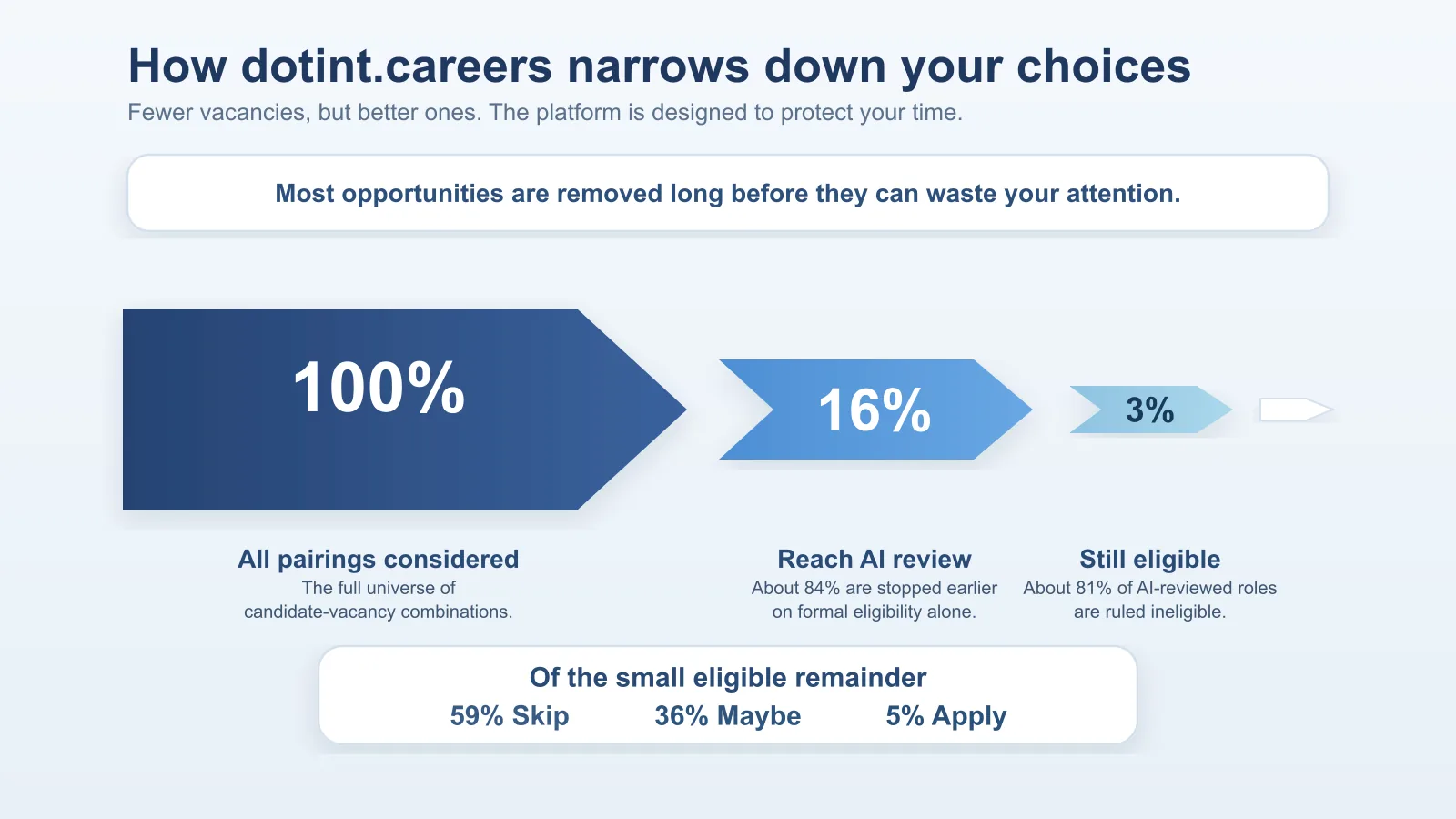
The philosophy of dotint.careers is almost the opposite of a classic job board.
The most precious resource in job search is your time. So we are not trying to impress you with a sheer number of opportunities that are really meant for somebody else. We are trying to save you time, so you can spend it working on applications of the highest possible quality.
That means the platform is built to show each candidate as few vacancies as possible, while still keeping the opportunities where they have the strongest realistic fighting chance. If a role is formally out of reach, or obviously misaligned with your profile and preferences, the right result is not to make you scroll past it. The right result is to keep it out of your way altogether.
That matters especially in international organisations, because their hiring is often highly formal. A role may sound close enough in substance, but still be a dead end for you because of grade, contract type, nationality restrictions, languages, education requirements, or other hard eligibility conditions.
So the first stage is strict filtering on formal eligibility. Historically, dotint.careers stops about 84% of candidate-vacancy pairings at this knockout stage before any AI-assisted review happens at all.
That is deliberate. It is better to reject an opportunity early than to let you spend time on something that was never realistically open to you in the first place.
Then comes the AI-assisted review. But that stage is not just about suitability or style. It is also another eligibility check. We look closely at the vacancy requirements and your profile, and flag further eligibility risks. A formal mismatch is still likely even though the pair got through the first screen: eligibility traps are frequently hidden in dark corners of vacancy texts.
Historically, among the opportunities that go on to receive an AI decision, about 81% are still marked ineligible at that stage.
Only once we are reasonably satisfied that you are eligible do we move to the next question: is this actually worth your time?
That is where dotint.careers sorts opportunities into three practical buckets:
- Skip: the role is technically in reach, but weak enough that we do not think it deserves your attention.
- Maybe: the opportunity has some plausible value, but comes with tradeoffs or weaker alignment, so it may be worth looking at depending on your priorities.
- Apply: this is where the platform sees the strongest overall combination of eligibility, fit, and practical promise.
Historically, among the opportunities that pass the eligibility stages and get sorted on suitability, about 59% land in Skip, 36% in Maybe, and just under 5% in Apply.
Look at the funnel as a whole and the picture becomes even clearer: only about 0.1% of all candidate-vacancy pairings considered by the system end up in Apply.
That is the work dotint.careers is meant to save you from.
In general, we recommend spending your time primarily on Apply-graded opportunities. But the platform does not force a single working style on everyone. In Preferences, you can choose how much to see. You can keep the list tight, expand visibility to Maybe, or, with a PRO account, view all vacancies the system considered for you.
Preferences are also where you can shape the matching more directly. You can set practical parameters around the kinds of organisations, grades, contract types, work modes, and other conditions you care about. And one field is especially important: the free-form preferences text box.
That is where you can describe what your dream job looks like in your own words, and just as importantly, what it does not look like. If you know that you want to stay close to a certain type of work, avoid a certain type of employer, focus on a region, or move away from specific assignments, that is the place to say it.
The more clearly you describe your priorities, the more sharply dotint.careers can narrow the field for you.
So the principle stays the same from start to finish: fewer choices, but better ones. We reject a very large share of opportunities early, we protect you from formal dead ends, and we push your attention toward the openings most likely to justify the effort of a serious application.
That is why the platform is not designed to show you everything. It is designed to help you spend your time where it has the best chance of paying off.