If you watched the platform over the Easter period, you probably felt it: the feed went quieter.
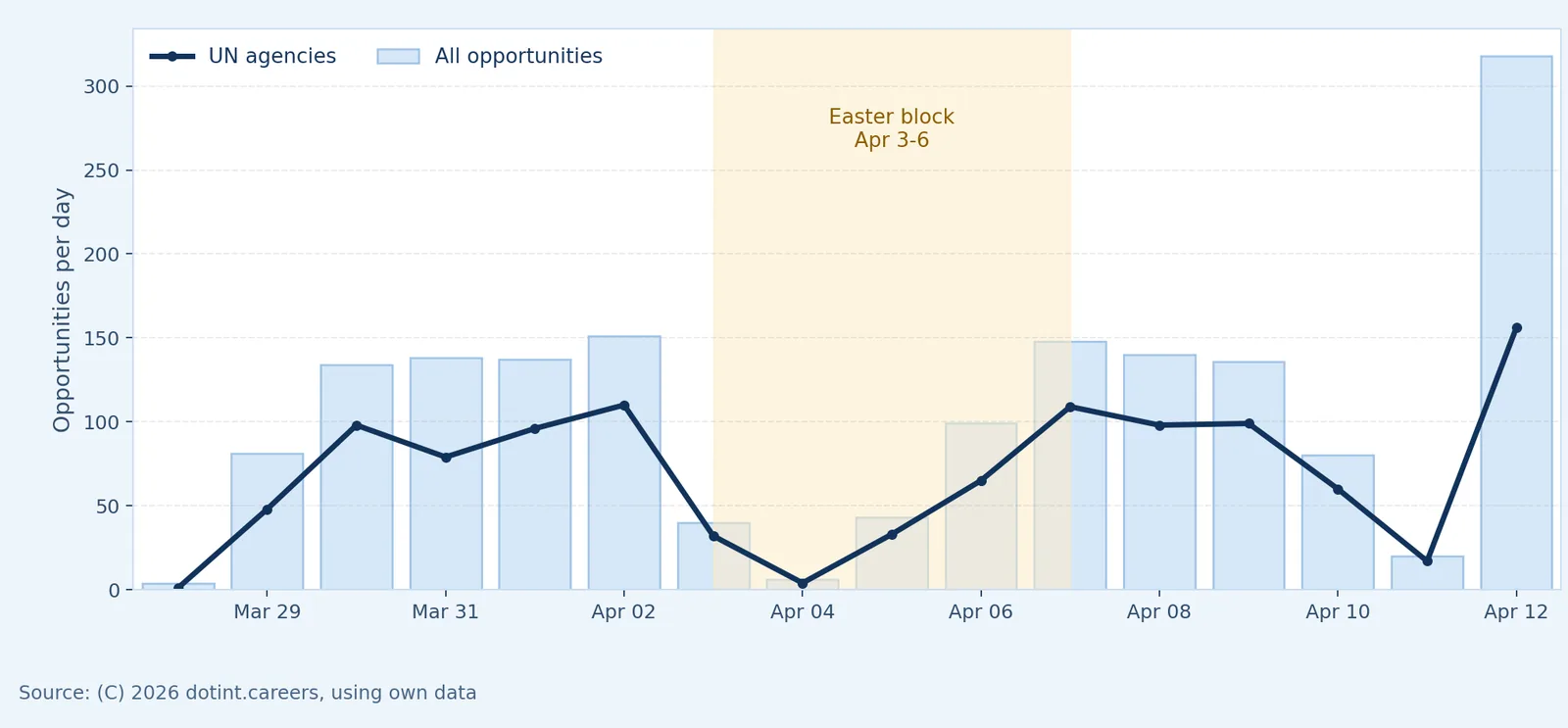
The data confirms that this was not just an impression. Between 28 March and 2 April, dotint.careers was seeing a steady flow of new opportunities each day. During the Easter block from 3 to 6 April, that dropped sharply. The rebound came quickly after that, and by Sunday 12 April the platform was seeing a major jump again.
UN agencies showed the clearest holiday effect. Before Easter they were contributing just over 80 opportunities per day on average. During the holiday block that fell to about 33.5. Other organisation types also slowed down, but less dramatically: NGOs and foundations kept moving at roughly 4.5 opportunities per day, other intergovernmental organisations did the same, and development banks and IFIs still produced a trickle.
The mix of opportunities changed too. Consultancies held up better than internships or junior professional roles. During the Easter block, consultancies still averaged 13.5 new postings per day, while internships averaged 3.8 and junior or early-career roles 4.0. Senior leadership hiring did not disappear either, but it became very sparse.
Geographically, Europe almost vanished from the feed over the holiday stretch. Across 3 to 6 April, only two Europe-located opportunities appeared in the data. One especially striking example landed on Easter Sunday itself: an Archival Research Analyst Internship in Luxembourg.
What happened on Sunday 12 April is also worth noting. The spike that day was not driven by a single publisher. It was spread across a cluster of organisations, including WHO, ITU, UNESCO, ESA, ICRC, IUCN, UNOPS, WWF, UNICEF, and IAEA. That makes the pattern look less like an isolated anomaly and more like batch publication behavior: roles being released in groups, even on a weekend.
That is probably the most interesting takeaway. Hiring in international organisations clearly slows around major holidays, and in some parts of the system it slows a lot. But it does not actually stop. Someone, somewhere, is still pushing roles live, clearing approvals, or letting automated workflows run while large parts of the world are officially off. And when work resumes, it may do so in bursts rather than in a smooth daily rhythm.
For candidates, that is a reminder not to assume the market is fully asleep just because the calendar says it should be. For organisations, it is a small but revealing signal about how international hiring really works: globally distributed, operationally uneven, and sometimes still very much alive when one region has mentally logged off.